Wednesday, March 26, 2008
Gothic City
Saturday, January 12, 2008
Second Valley Diving
Monday, January 07, 2008
Port Noarlunga - A place to swim
A strangely high number of the hits on this blog are searching for info on snorkeling at Port Noarlunga. Consequently for this post I will describe the site a little.
It is one of the most popular SCUBA/snorkeling/swimming sites in South Australia.
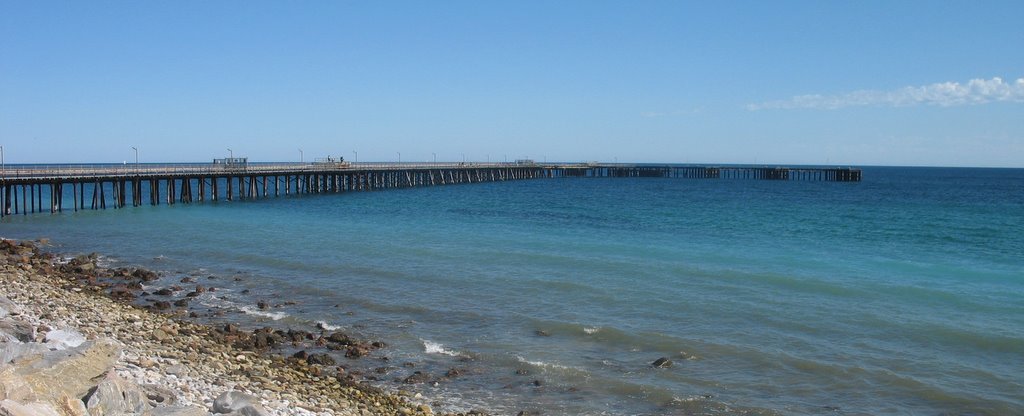
From the aerial photo it can be seen that there is a jetty which runs out to a reef.
Jetty.
The jetty has two sets of steps. One at the very end, near the reef, and one about half way along. That is, about a third of the way between the mid tide mark and the reef.
Reef
The reef runs parallel to the shore about 400m out. It is a natural limestone feature in temperate waters (unlike the coral reefs generally associated with the tropics) and is more than 1500m long, but only a few metres wide. I think the natural reef has been supplemented by various debris over the years. There is a gap in the southern part of the reef which allows swimmers to pass through to the seaward side if they choose to. The reef gives shelter, from the open gulf, to swimmers (and fish!) on the shoreward side, particularly at low tide. However, care should always be taken as there can be strong drift (north or south) even inside the reef. It is best to swim into the current when beginning your swim, so that later when coming home you will be aided by the current rather than have to fight it when tired. While Port Noarlunga is a popular and relatively safe area, there are often no formal life saving or other services on hand, so assesing the suitability/safety of conditions is the responsibility of the swimmer.
At high tide the waves from the gulf pass over the reef. They carry particles and bubbles, so visibility is reduced. The seaward side of the reef carries a more luxuriant layer of sea vegetation, chiefly kelp. Between the reef and the low tide mark is a sandy floor with extensive areas of weeds and sometimes shell fish.
Reserve
The whole area is a marine reserve which means that bait digging, spearfishing, line fishing within 25 metres of the reef or within 50 metres of the end of the jetty, collecting or removing anything (fish, shells etc) are all prohibited activities. There is a "marine trail" with 12 underwater markers (and one anchor!) which can be followed.
What you will see.
The usual way to enter the water is to walk to the extreme end of the jetty and use the steps there. Except for the last 50m of the jetty, line fishing is allowed and you will see what fish are biting at the time. Once in the water at the steps you will see thick schools of fish (Zebra Fish, Sweep, Leather Jackets, Whiting etc). They wait there to be fed by divers and others. The Jetty legs have metal bars attached for convenient handholds and the water is about 6-9m deep here. Swimming directly out from the jetty end puts you next to the reef within a few metres. Then travelling slowly north or south will give you the opportunity to see the various sea life along the reef. Most obvious will be Old Wives, Magpie Perch (feeding on the reef) Leather Jackets, Wrasse, Bryzoans, Starfish, SeaUrchins and Sponges. Reputedly there are over 200 species of marine life on the reef, including 38 species of fish.
Of course, the reef environment is fragile, with so many people visiting it, care should be taken to avoid touching anything if possible.
If you decide to swim back to the shore from the reef (or start by approaching the reef from the shore) either keep wholly underneath the jetty or swim many metres away from it in order to give the maximum clearance to the lines of people legitimately fishing from the jetty.

Monday, December 10, 2007
Porifera (Sponges)
phylum Porifera - sponges
Porifera translates to "Pore-bearer". They are the simplest multi cellular animals. They are sessile, mostly marine, water dwelling, filter feeders that pump water through their bodies to filter out particles of food matter. With no true tissues (parazoa), they lack muscles, nerves, and internal organs.
There are three (4?) classes of porifera.
1. Calcarea (calcareous or boney sponges) are the only sponges that possess spicules composed of calcium carbonate. Typically, the Calcarea are very small, measuring about 3-4 inches in height. Of the 15,000 or so species of Porifera that exist, only 400 of those are Calcareans
2. Hexactinellid (glass sponges) are sponges with a skeleton made of four and/or six-pointed silaceous spicules.
Hexactinellids are relatively uncommon and are mostly found at substantial depths.
3. Demosponge:
The Demospongiae are the largest class in the phylum Porifera. Their "skeletons" are made of spicules consisting of fibers of the protein spongin, the mineral silica, or both. They contain 90% of all species of sponges and are predominantly leuconid structural grade.
Subclass Homoscleromorpha
order Homosclerophorida
Subclass Tetractinomorpha
o Astrophorida
o Chondrosida
o Hadromerida
o Lithistida
o Spirophorida
Subclass Ceractinomorpha
o Agelasida
o Dendroceratida
o Dictyoceratida
o Halichondrida
o Halisarcida
o Haplosclerida
o Poecilosclerida
o Verongida
o Verticillitida
4(?). Sclerospongiae (coralline or tropical reef sponges)
----------------------------------------------------
Glossary of Terms:
Archaeocytes (amoebocytes) - Cells with pseudopods, located in the mesohyl. They are used in processing food, distributing it to other cells, and for other functions.
Choanocyte - also called collar cells, choanocytes line the inner cavity of the sponge. They have a sticky, funnel-shaped collar (that collects food particles) and a flagellum (which whips around, moving water). The sponge obtains its nutrients and oxygen by processing flowing water using choanocytes. Choanocytes are also involved in sponge reproduction; they catch floating sperm.
Mesohyl (mesenchyme) - the gelatinous layer between the outer body of the sponge and the spongocoel (the inner cavity).
Oscula (pl. osculum) - a large opening in a sponge through which water flows out of the sponge. Sponges may have more than one oscula.
Ostium (pl. ostia) - a pore on the body of a sponge that lets water into the sponge.
Pinacocyte - pinacocytes are the thin, flattened cells of the epidermis, the sponge's outer layer of cells.
Porocyte - cells with pores that allow water into the sponge; they are located all over the sponge's body.
Spicule - spicules are sharp spikes located in the mesohyl. Spicules form the "skeleton" of many sponges.
Spongin - the flexible, fibrous fibers that form the skeleton of horny sponges; spongin is located within the mesohyl.
Spongocoel - the central, open cavity in a sponge through which water flows.
Friday, February 09, 2007
A Night Dive at ...
Monday, January 01, 2007
The Swimming Song...
This summer I might have drowned
But I held my breath, I kicked my feet
Moved my arms around
I moved my arms around
(Lyrics: Loudon Wainright III)
Well, finished my diving course yesterday, so a bit of a burst from me.
I now have the grand total of 4 salt water dives (and a day splashing in a pool) under my belt and am a fully (fooly?) qualified open water diver.
Most interesting thing I found though after all the big kerfuffle about past asthma, the thing which (I think) would really threaten to bump people off is carrying the _bloody gear_ in the heat of summer. Nobody mentioned that (other than in very oblique passing).
On the first day in the sea we went to Port Noarlunga reef (I have done some snorkelling there so it wasn't unfamiliar territory). First dive we dressed on the lawns and walked out to the first steps (about midway along the jetty). That was a bit of a struggle, but once in the water it becomes very easy as a person becomes neutrally bouyant (or near enough). Later in the day we went out to the far end of the jetty, a much longer walk. After the second dive, my partner was so tired I offered to carry her weight belt back. It was only when I was laying in bed that night I started to put 2 and 2 together. Each belt (hers and mine) weighed 12 kg. My tank was about 15kg (empty) as far as I can tell. 15+12+12=39 kg (not counting a few extra kilos for vests, suit, regulators and miscellaneous swimming paraphenalia). Thirty nine _bloody_ kilograms. That's more than half my body weight! If I did this sort of thing for a job, there would be OH&S rules against it! So I went out first thing next morning and bought a cheap sack truck to carry the gear on. :-) What a huge difference it made to get into the water breathing normally and not too overheated to start with. After the three swimming days I had lost 2 kg of body weight. Very gratifying, but hard work!
I am still amazed that some of the smaller folks (a late teeneage girl and her younger brother) could carry the stuff so apparently easily without dying in the heat.
Anyway, far from the above gripe might sound, it was pretty good fun. Never drowned, never got eaten by sharks, didn't get stuck down there and no noticeable effects on my breathing. The instructor wants to gee us all up so is organising a boat trip to "the dredge" off Glenelg in the next couple of weeks. I am looking forward to that :-)